Leash Training a American Staffordshire Terrier: Pulling, Lunging and Loose-Leash Walking
General training information. Every dog is an individual; for health or behavior concerns, see your veterinarian.
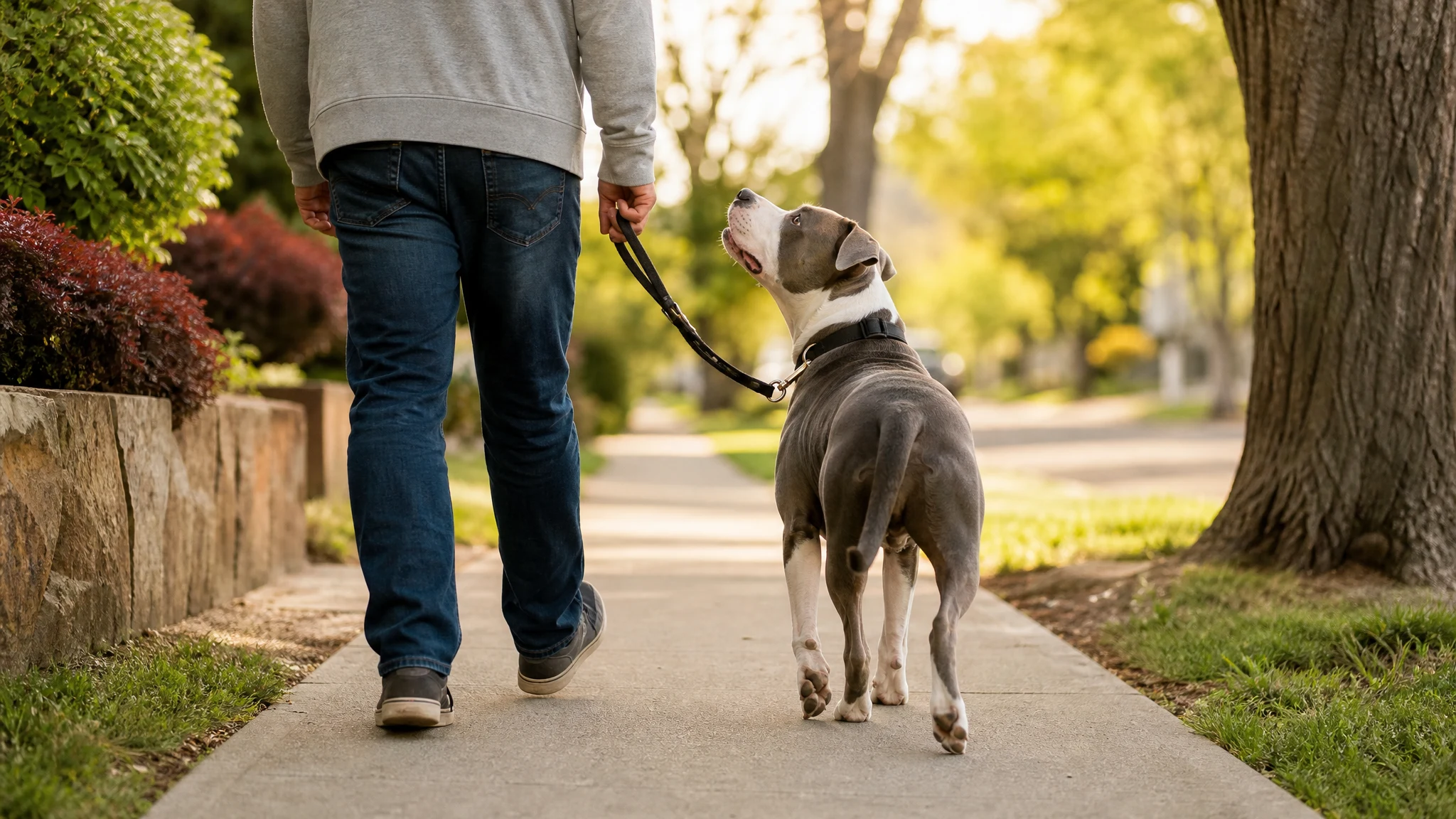
Most owners learn quickly that a strong, eager dog on the end of a leash can feel like a sled team. American Staffordshire Terrier leash training is mostly about teaching a keen, athletic dog that walking beside you pays better than hauling you down the street.
This guide covers why the breed pulls, the gear to use, a step-by-step plan, and what to do when your dog lunges at dogs, people or squirrels. It builds on the basics in our complete guide to training an American Staffordshire Terrier.
Why an American Staffordshire Terrier Pulls
Pulling is not stubbornness for its own sake. It is a dog doing what works. If a tight leash gets them to the interesting smell, the pulling gets rewarded every time.
The Staffordshire Terrier Club of America describes the breed as strong, athletic and intelligent, and also driven to please. The same club says individual dogs can be strong willed, exuberant, impulsive and sensitive. That mix explains a lot. A dog that is eager and impulsive will charge ahead, and a dog that wants to please can learn a better habit quickly when you make it clear and rewarding.
Breed history plays a part too. The club's history page notes that the breed's Bulldog ancestors were bred for baiting bulls, and that the breed also has a history as catch dogs for hunters and ranchers. Vetstreet, a secondary source, says the breed may pull, dig and chew, and may see cats and small animals as prey. So squirrels, rabbits and neighborhood cats can set off a sudden lunge. Individual dogs vary, so watch your own dog rather than assuming.
Westminster Kennel Club rates the breed 3 out of 5 for energy and 3 out of 5 for trainability. That is a middle-of-the-road rating, which fits what most owners find: the dog can learn this, but you need to practice and keep it interesting.
What You Need
- A flat collar with ID tags, fitted so you can slip two fingers under it.
- A front-clip harness that fits well. The leash clips at the chest, which gently turns your dog back toward you when they surge ahead.
- A standard 4 to 6 foot leash. Skip retractable leashes. They teach dogs that pulling extends the leash.
- Small, soft treats your dog loves, cut pea-sized so you can deliver many of them.
- A treat pouch or pocket for quick access.
- A quiet starting place such as a hallway, yard or empty driveway.
What to leave in the drawer: prong collars, choke collars and shock collars. The American Veterinary Society of Animal Behavior (AVSAB) supports reward-based training, and these tools rely on discomfort. They can also make a dog link the pain with whatever they were looking at, which is a bad trade if the dog is already reactive.
One health note. If your dog gags, coughs or makes noisy breathing sounds when the leash tightens, stop and call your veterinarian. The parent club's health page lists juvenile laryngeal paralysis and polyneuropathy (ALPP) as a concern in the breed, with signs typically appearing before 6 months. Your vet is the right person to sort out what is going on.
How to Leash Train an American Staffordshire Terrier, Step by Step
1. Get your dog comfortable with the gear
Let your dog sniff the harness, then feed a treat. Slip it on, feed a treat, and take it off. Repeat over a few short sessions until your dog perks up when the harness appears.
Clip on the leash indoors and let them drag it around while you supervise. Pick it up and walk a few steps, rewarding any moment your dog is near you.
2. Teach the "check-in" game
Stand in a quiet room. Each time your dog looks at you, say "yes" and give a treat. Do this for a minute or two, a few times a day.
Soon your dog will offer eye contact on their own. This is the foundation for everything else, because a dog who looks to you for information is a dog who is not looking for a squirrel.
3. Mark and reward the position you want
Pick a side, left or right, and stick with it. Hold treats at your hip. When your dog is beside you with a loose leash, say "yes" and drop a treat right by your leg.
Take two steps. If your dog is still beside you, mark and reward again. Build up slowly to five steps, then ten. Reward often at the start. You are paying for the habit.
4. Add the "stop when it's tight" rule
The moment the leash goes tight, stop walking. Stand still like a tree. Do not yank or scold.
When your dog looks back or steps toward you and the leash slackens, say "yes" and walk on. Your dog learns that a tight leash means the walk stops and a loose leash means the walk continues.
This takes patience. A short walk may take ten minutes at first. That is normal.
5. Use turns to keep your dog tuned in
If your dog drifts ahead, say "this way" cheerfully, turn and walk the other direction. Reward when your dog catches up. Frequent direction changes keep an impulsive dog watching you instead of locking on to the next distraction.
6. Play loose-leash games
These make the work fun, which matters for a breed the parent club says should have training that is fun and diverse.
- Treat scatter: Toss a few treats on the ground and say "find it." Let your dog sniff, then walk on. It gives sniffing a legal outlet.
- Zigzag: Walk in a zigzag pattern and reward your dog for keeping up beside you.
- Speed up, slow down: Change your pace. Reward your dog for matching it.
- Sniff break release: Teach a cue such as "go sniff" that gives permission to pull toward a good smell on a loose leash. A dog that knows when sniffing is allowed pulls less the rest of the time.
7. Take it outside, then add distractions
Start in the yard or driveway. Once your dog does well there, move to a quiet street at a calm time of day. Expect your dog's skills to dip when the setting changes. Go back to rewarding often.
Add challenges one at a time: a parked car, a neighbor in the distance, a busier sidewalk. Keep sessions short, five to ten minutes, and end on a win.
What to Do About Lunging
Lunging at dogs, people, bikes or small animals is a different problem from ordinary pulling. The dog may be excited, frustrated, nervous or following prey drive. The first step is to learn what your dog's trigger is and how close you can get before they react.
Find the threshold distance
Notice the distance at which your dog sees the trigger but can still take a treat and respond to you. That is your working distance. Stay at or beyond it.
Reward calm looks
When your dog sees the trigger and stays calm, say "yes" and treat. Then move away before they get worked up. Over many sessions you can slowly decrease the distance, but only as long as your dog stays relaxed.
Use a U-turn as an escape
If your dog stiffens, stares or starts to rise up on the leash, turn around calmly and walk away, feeding treats as you go. Do not wait for the lunge. Leaving early protects your dog from practicing the behavior.
Be careful around other dogs
The Staffordshire Terrier Club of America says dog aggression can develop even in well-socialized dogs. It advises heavily socializing puppies and young adults with other dogs, and never leaving an American Staffordshire Terrier alone with other dogs. On walks, that means keeping your dog's space, skipping greetings with unknown dogs on leash, and crossing the street when needed. Tight leashes and face-to-face greetings can make things worse.
If your dog's lunging comes with growling, snapping or intense fixation, or if you feel you cannot manage it safely, ask your veterinarian for guidance. They can rule out pain or other medical causes and may refer you to a qualified, reward-based behavior professional.
Handle prey triggers
For squirrels, cats and rabbits, distance and management matter most. Keep your dog's attention with treats, walk at quieter times and avoid areas with lots of wildlife while the skill is new. A fully secure leash and a well-fitted harness matter more here than anywhere else.
Tips for Better Walks
- Exercise first. Vetstreet describes the breed as athletic and suited to active owners, with many dogs enjoying swimming and retrieving. A short game of fetch before the walk can take the edge off. Neither the club nor Vetstreet gives exercise minutes, so ask your vet what is right for your dog's age and health.
- Start early. Vetstreet advises not waiting until a puppy is 6 months old to begin training, and recommends puppy kindergarten and socialization.
- Keep the leader role calm and clear. The parent club says the owner should take the leader role early and keep it as the puppy matures. Think of that as consistent guidance and good management, not force.
- Pay generously. The harder the distraction, the better the treat.
- Keep your hands soft. Hold the leash with a relaxed grip. A tense leash tells your dog something is wrong.
- Be consistent. If one family member lets the dog pull, the training slows down.
Common Mistakes to Avoid
- Letting the dog pull "just this once." Pulling that works even occasionally will stick around.
- Yanking or leash corrections. These can hurt your dog's neck and damage trust. This breed is described as sensitive by its parent club.
- Using pain-based tools. Prong, choke and shock collars are not part of reward-based training.
- Going too fast. Jumping straight to a busy park sets your dog up to fail.
- Using the leash for greetings. Face-to-face greetings on leash often cause tension.
- Skipping the rewards too soon. Fade treats slowly, and keep some in your pocket for life.
- Training when you are rushed or angry. Dogs read your mood.
What Results to Expect
Many owners find that, with regular short practice, a dog begins to walk more calmly within a few weeks. Some dogs take longer, especially adolescents, dogs with strong prey drive and dogs that have practiced pulling for years. Progress is rarely a straight line, and no method can promise a specific outcome.
You may notice your dog checking in more often, recovering faster after a distraction and keeping the leash slack for longer stretches. Lunging at triggers often improves slowly and may need ongoing management. Track small wins, such as a bigger distance from a trigger or a quicker turn back to you.
If you feel stuck, a reward-based trainer can watch you and your dog in person. Check any trainer's methods first and avoid anyone who uses pain, fear or dominance.
A Simple Weekly Plan
- Week 1: Gear comfort, check-in game and rewarding position indoors.
- Week 2: Stop-when-tight rule and turns in the yard.
- Week 3: Quiet streets, loose-leash games and sniff-break cue.
- Week 4 and beyond: Add mild distractions and work on trigger distance.
Treat this as a rough guide. Move at your dog's pace.